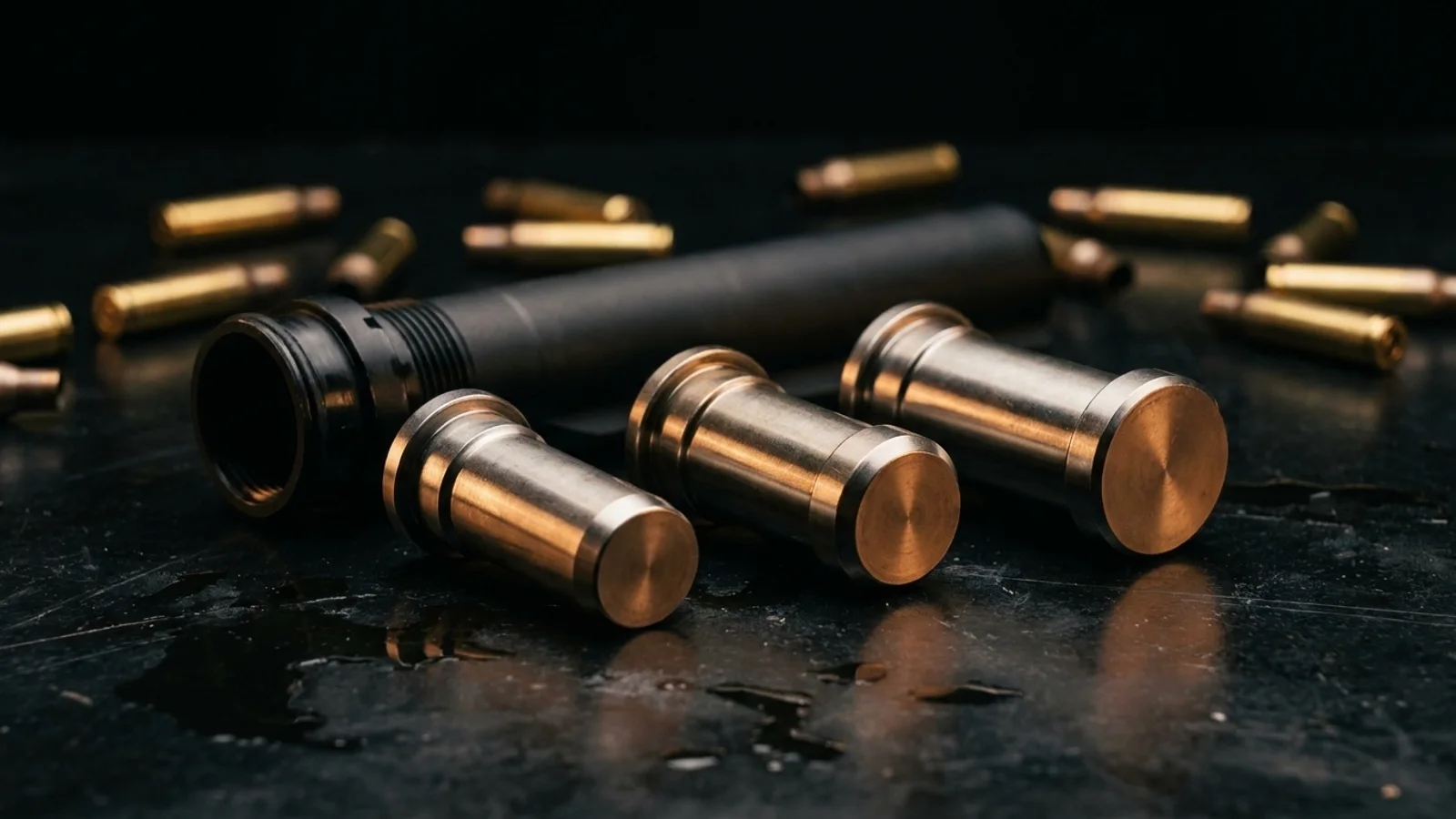
AR-15 Buffer Weights
Pick the right buffer weight for your AR.
Carbine, H1, H2, H3, H4 — what they weigh, when to use them, and how to diagnose your build. Pick a preset or configure your gas system, barrel length, and use case for a tuned recommendation.
Quick presets
Why: Mid-length gas is the most popular AR-15 configuration. H2 is the standard recommendation for 14.5-16 in barrels in mid-length. Move to H3 if suppressed.
Likely undergassed. Drop to H1 — your rifle's gas output won't push H2 with enough margin.
Likely overgassed. Move up to H3 or add an adjustable gas block.
Full buffer reference
| Buffer | Weight | Best for |
|---|---|---|
Carbine | 3 oz | Carbine gas system + short barrels (10.5-14.5 in) |
H1 | 3.8 oz | Carbine gas system + 16-in barrels |
H2· picked | 4.65 oz | Mid-length gas system (standard recommendation) |
H3 | 5.4 oz | Rifle-length gas systems (16-20 in barrels) |
H4 | 6.4 oz | Piston AR-15 (LWRC, POF, Sig MCX) builds that need extra dwell-time tuning |
PCC | 7 oz | 9mm PCC (typically 5.0-5.6 oz) |
Detail Reference
Every buffer, explained
The lightest standard buffer. Original spec for short-barrel carbines with carbine-length gas systems. Often runs hot on M4-spec rifles with full-power 5.56.
- Carbine gas system + short barrels (10.5-14.5 in)
- Lower-power loads (.22 LR conversions, .300 BLK subsonic with pistol gas)
- Underpowered uppers that won't cycle with heavier buffers
The default 'gentle upgrade' from carbine. One steel weight + two tungsten powder weights internally. The smallest change you can make to tame felt recoil on a carbine-gas 16-in build.
- Carbine gas system + 16-in barrels
- Standard 5.56 / .223 builds where carbine feels too sharp
- Light-recoil competition builds
The most versatile single buffer for AR-15. Two steel weights + one tungsten powder. Pairs reliably with mid-length gas systems, 14.5-16 in barrels, and most pistol builds. The 'tune it later if needed' default.
- Mid-length gas system (standard recommendation)
- 14.5-16 in barrels with standard 5.56
- AR pistols (often the right starting point)
Maximum standard buffer weight. Three tungsten powder weights internally. Used when you're definitely overgassed — typically rifle-length gas, suppressed setups, or competition where you want minimum bolt-velocity at the cost of slightly slower lock time.
- Rifle-length gas systems (16-20 in barrels)
- Suppressed builds with fixed gas blocks
- Heavy match loads in 5.56 with extended dwell time
Aftermarket extra-heavy buffer. Not part of the original mil-spec set. Used in piston-AR systems and badly overgassed dedicated suppressor hosts. Limited adoption.
- Piston AR-15 (LWRC, POF, Sig MCX) builds that need extra dwell-time tuning
- Bolt-action-style smooth-recoil precision setups (rare)
Heavy buffer specifically for pistol-caliber AR (PCC) blowback systems chambered in 9mm, .40 S&W, or .45 ACP. PCC blowback action has no gas system — it relies on a heavy bolt + heavy buffer to delay opening. Weight is matched to the cartridge and bolt mass.
- 9mm PCC (typically 5.0-5.6 oz)
- .45 ACP PCC (often 7-8.5 oz)
- Glock-pattern mag PCCs (depends on bolt + spring)
Why buffer weight matters
The buffer sits inside your AR-15's receiver extension (buffer tube) and gets pushed rearward by the bolt carrier on every shot. Its mass + the action spring control how fast the bolt opens and how hard the carrier slams the back of the tube. Get the weight wrong and you get one of two problems:
- Too light: bolt opens fast, dwells too short, brass ejects at 1-2 o'clock, felt recoil is sharp, carrier wears the rear of the tube, and the bolt face takes extra impact on lockup.
- Too heavy: bolt doesn't travel far enough, you short-stroke, fail to lock open on empty, sometimes fail to pick up the next round. The cycle becomes unreliable.
A correctly-weighted buffer gives you ejection at 3-5 o'clock (brass landing in a neat pile a few feet to your right and rear), smooth recoil impulse, and reliable lockback on empty mags.
How the recommendation works
The picker above maps three inputs to a buffer choice:
- Gas system length — pistol (~4") is the shortest dwell, rifle (~12") is the longest. Longer gas = more gas pressure hitting the bolt = needs more buffer mass to slow it.
- Barrel length — controls dwell time independently of gas length. A 14.5" carbine-gas runs hotter than a 16" carbine-gas because the bullet exits the muzzle sooner relative to the gas port.
- Use case — duty/defensive shooters want reliability margin, competition shooters want speed, suppressed shooters need to absorb extra gas pressure.
Diagnosing buffer-weight problems
When you swap buffers, fire 50-100 rounds of your typical ammo and read the rifle:
- Ejection pattern — best-case is 3-5 o'clock, tight cluster 5-10 ft away. Brass at 1-2 o'clock means overgassed (heavier buffer or close gas block). Brass at 4-7 o'clock means undergassed (lighter buffer or open gas block). Brass dropping straight down is mid-range.
- Bolt lockback — does the rifle lock open on empty, every time? If yes, you have enough gas to cycle. If sometimes, you're on the edge — probably need a lighter buffer or more gas.
- Felt recoil — sharp, jumpy = overgassed. Soft, smooth = well-tuned. Sluggish = could be undergassed or could be buffer just too heavy.
- Bolt face condition over time — premature wear on the bolt face or recurring cracked bolt lugs is often a buffer-too-light symptom in a hard-use rifle.
Buffer-weight isn't the only lever
Three other parts of the action work alongside the buffer:
- Action spring — carbine (10.6-12.5 in length), rifle (12.75-13.5 in), or the modern flat-wire variants from Sprinco/Tubb. Heavier spring + lighter buffer is sometimes equivalent to lighter spring + heavier buffer.
- Adjustable gas block — the cleanest way to handle overgassed builds. Lets you dial down the gas at the source instead of compensating downstream with mass.
- Bolt carrier weight — low-mass carriers (e.g., JP) move faster and need less buffer mass; full-auto carriers move slower and may need lighter buffers in some configurations.
Most users solve their problems with buffer weight alone. If you've tried two buffer weights and still can't get the rifle to run right, the issue is upstream — gas port, spring, or carrier.
Common Questions
Buffer Weight FAQ
What buffer should I run in my AR-15?+
Default starting points by gas system: pistol-length → H2, carbine-length → H1 or H2, mid-length → H2, rifle-length → H3. The interactive picker on this page maps gas + barrel + use case to a recommendation. These are starting points — final tuning is done at the range by reading ejection pattern (3-5 o'clock direction = correctly gassed, 1-2 o'clock = overgassed, 4-7 o'clock = undergassed).
What's the difference between H1, H2, and H3?+
It's the count of tungsten powder weights inside the buffer body. A carbine buffer has three steel weights. H1 swaps one steel for one tungsten powder weight, adding ~0.8 oz over carbine. H2 swaps two of three for tungsten powder, adding ~1.6 oz. H3 has all three weights as tungsten powder, adding ~2.4 oz over a baseline carbine. More tungsten = more inertia = slower bolt velocity = softer felt recoil + later unlocking.
Do I need a heavier buffer when running a suppressor?+
Almost always yes. A suppressor traps gas at the muzzle and increases bolt-carrier velocity by 20-40% on a typical setup. The fix is some combination of: heavier buffer (one step up from your unsuppressed weight is the rule of thumb — H2 → H3), an adjustable gas block, or a flow-through suppressor design. If your rifle was correctly gassed unsuppressed at H2, expect to need H3 with a can attached. If you don't compensate, you'll see brass land at 1-2 o'clock, increased bolt face wear, and harder cycling on weaker loads.
How do I know if I'm overgassed or undergassed?+
Three diagnostic signals. (1) Ejection pattern with brass-cased ammo: 3-5 o'clock = correctly gassed; 1-2 o'clock = overgassed (heavier buffer or close gas block); 4-7 o'clock = undergassed (lighter buffer or open gas block). (2) Sharp, jumpy felt recoil with significant muzzle rise = overgassed. (3) Failure to lock the bolt open on an empty mag = undergassed. The buffer weight is one variable in the equation — gas port size, dwell time, and ammunition pressure also matter. Diagnose before throwing parts at it.
Will a heavier buffer hurt reliability?+
Only if you go too heavy for your gas system to push. The bolt carrier still needs to travel rearward enough to clear the magazine well and pick up the next round on its forward stroke. If you put an H3 on an undergassed upper, you'll see short-stroking — the bolt won't travel far enough to lock open on empty, or it'll stovepipe the next round. The rule: only go up one buffer weight at a time, then test 100+ rounds before going heavier.
What's an H4 or extra-heavy buffer?+
H4 (~6.4 oz) is an aftermarket extra-heavy buffer beyond the mil-spec H3. It's most useful for piston AR-15 systems (LWRC, POF, Sig MCX) where you want extra dwell tuning, or for badly overgassed dedicated suppressor hosts where H3 isn't enough. For DI (direct-impingement) AR-15s, almost nobody needs an H4 — if you're past H3, the right fix is usually an adjustable gas block, not more buffer mass.
PCC (9mm AR) — what buffer goes there?+
PCCs run blowback action — no gas system. The buffer weight + bolt mass + spring strength together control unlock timing. Common starting points: 9mm with Glock-pattern mags = 5.0-5.6 oz; 9mm Colt-pattern = 5.5-6.5 oz; .45 ACP = 7-8.5 oz. PCC buffers are sold specifically for caliber matching — don't drop a rifle H3 into a PCC build expecting it to work. Manufacturers like Kynshot and KAK make PCC-specific buffer kits.
Does barrel length matter for buffer choice?+
Indirectly, yes — through dwell time. Dwell time = how long the bullet stays in the barrel past the gas port, which determines how much gas reaches the bolt. Longer dwell = more gas = more bolt velocity. A 14.5-in carbine-gas barrel has shorter dwell than a 16-in rifle-gas barrel; both want different buffers. The interactive picker above already accounts for this — pick your gas length AND barrel length, and the recommendation adjusts.