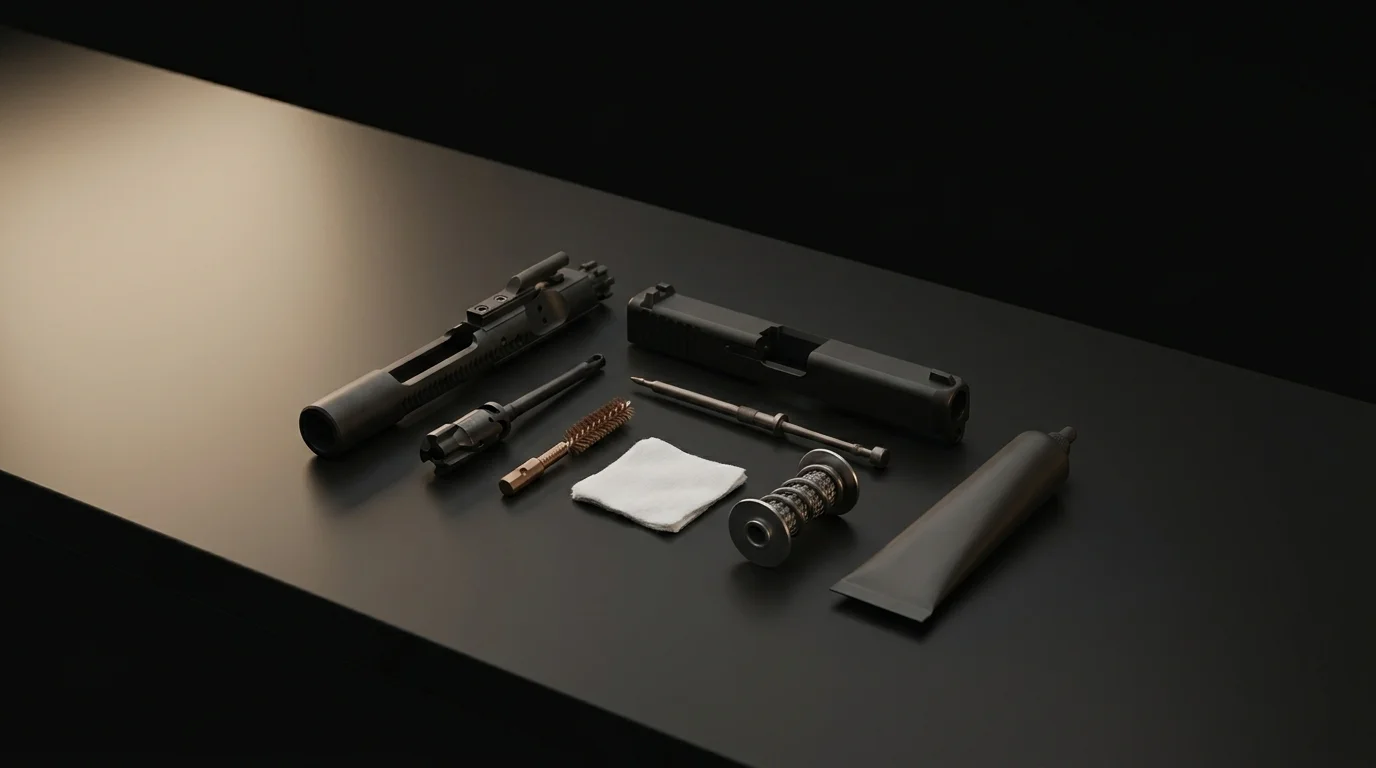
Universal safety check (do this every single time)
- Remove the magazine. Verify it's out and set it aside.
- Rack the slide / charging handle three times. Any chambered round ejects.
- Visually inspect the chamber. Look into the chamber and ejection port. Confirm it's empty.
- Stick a finger in the chamber. Some people skip this; don't. The tactile confirmation catches the case-the-eye- missed scenario.
- Point in a safe direction for the rest of the procedure. Treat it as loaded even after the check.
What you need (universal kit)
- Bore solvent — Hoppe's No. 9, Boretech Eliminator, or M-Pro 7
- Bore brush in your caliber (bronze or nylon)
- Cleaning rod or bore snake in your caliber
- Cotton patches sized to your caliber
- Nylon brush (a worn toothbrush works fine) for the action and exterior
- Lube — Slip 2000 EWL, CLP (Cleaner-Lubricant- Protectant), or Mobil 1 synthetic motor oil
- Microfiber cloth for wipedown
- Eye protection (solvent flecks happen)
- Newspaper or shop mat — solvents will stain wood and counter surfaces
How to clean a striker-fired pistol (Glock, P320, M&P, etc.)
- Safety check per above. Magazine out. Verify chamber empty.
- Field strip. For most striker-fired pistols: pull the slide back ~1/4 inch, pull down the takedown lever (or pull both takedown tabs in Glock's case), then ease the slide forward off the frame. For Glocks specifically, you may need to dry-fire first before the takedown levers will pull. Check your manual.
- Remove the recoil spring assembly from inside the slide. Then remove the barrel.
- Run the bore brush. Wet with solvent, push through the bore 4-5 times. Always brush in one direction (chamber to muzzle); never reverse mid-stroke or you'll damage bristles.
- Run patches. 3-5 wet patches, then 3-5 dry patches. Stop when patches come out reasonably clean. They won't come out PERFECTLY white — that's normal.
- Clean the slide interior. Solvent on the nylon brush, scrub the breech face, extractor area, slide rails, and the inside of the slide. Wipe down with patches.
- Clean the frame. Brush the trigger area, slide rail cuts on the frame. Don't over-do solvent in the frame — it can get into the trigger mechanism and isn't necessary.
- Lube. 1 drop of oil on each slide rail (4 total points), 1 drop on the barrel hood (where it contacts the slide), 1 drop down the muzzle end of the barrel. That's it. Glocks specifically don't want a lot of oil — too much makes them jam.
- Reassemble. Reverse the field-strip order. Function check: rack the slide, dry-fire on a verified-empty chamber, confirm everything operates smoothly.
How to clean an AR-15
- Safety check. Magazine out. Charging handle back, bolt locked open. Verify chamber empty visually and tactilely.
- Push out the takedown pins. Use a punch or the rim of a 5.56 case. Separate the upper from the lower receiver.
- Remove the bolt carrier group. Pull the charging handle back, slide the BCG out the rear of the upper. Then pull the charging handle out.
- Disassemble the BCG: Remove the firing pin retaining pin (the cotter pin at the rear of the carrier). Lift out the firing pin. Rotate the cam pin 90° and lift it out. The bolt slides out the front of the carrier.
- Clean the bolt. Solvent on the nylon brush, scrub the bolt face (especially the carbon-caked area around the extractor and the locking lugs). Wipe with patches. Don't obsess about the bolt tail's carbon — it's harmless and re-accumulates immediately.
- Clean the carrier interior. Patches and the nylon brush. Carbon will be heavy in the gas key area; that's normal.
- Bore-clean the barrel. Bore brush wet with solvent, 5 passes chamber-to-muzzle. Patches until reasonably clean. Then one dry patch.
- Clean the upper receiver interior. Wipe with a patch. The chamber face deserves attention with the nylon brush.
- Lube the BCG. Generous oil on the bolt itself, the cam pin, the inside of the carrier (where the bolt rides), and the rails on top of the carrier. The AR-15 wants to be wet. Resist the urge to wipe it dry.
- Reassemble. Bolt into carrier (extractor on the right side as viewed from the rear). Cam pin in, rotate 90°. Firing pin in. Cotter pin to retain. Charging handle in upper, BCG in behind it. Takedown pins, function check.
What NOT to do
- Don't scrub a rifle barrel with steel brushes. Bronze or nylon only. Steel will scratch.
- Don't reverse direction mid-stroke with a brush in the bore. Pull through completely, then reset.
- Don't over-clean a precision barrel. Excessive solvent + scrubbing strips the "fouling" that delivers consistent accuracy. Clean when groups open up, not schedule-based.
- Don't lube the firing pin channel on a striker-fired pistol. Oil in there can dampen the firing pin and cause light strikes.
- Don't store with solvent in the bore. Long-term, ammonia-based solvents can etch. Always wipe dry and leave a light protective oil film for storage.
- Don't treat a hard-use AR like a precision rifle. Wet runs wet. Lube the BCG well, top off regularly, deep clean every 1,000-2,000 rounds and not before.
Long-term storage prep
If a firearm is going into safe storage for > 3 months:
- Full clean per above.
- Wipe down all metal surfaces with a light protective oil (CLP, Renaissance Wax, or Frog Lube). The goal is a microscopic film of rust-prevention.
- Store in a controlled-humidity environment. A dehumidifier rod in your gun safe (Goldenrod, Lockdown) at 40-50% RH prevents 99% of rust problems.
- Avoid storing in a soft case for long-term — the foam can hold moisture against the metal. Hard cases or open racking with dehumidification is better.