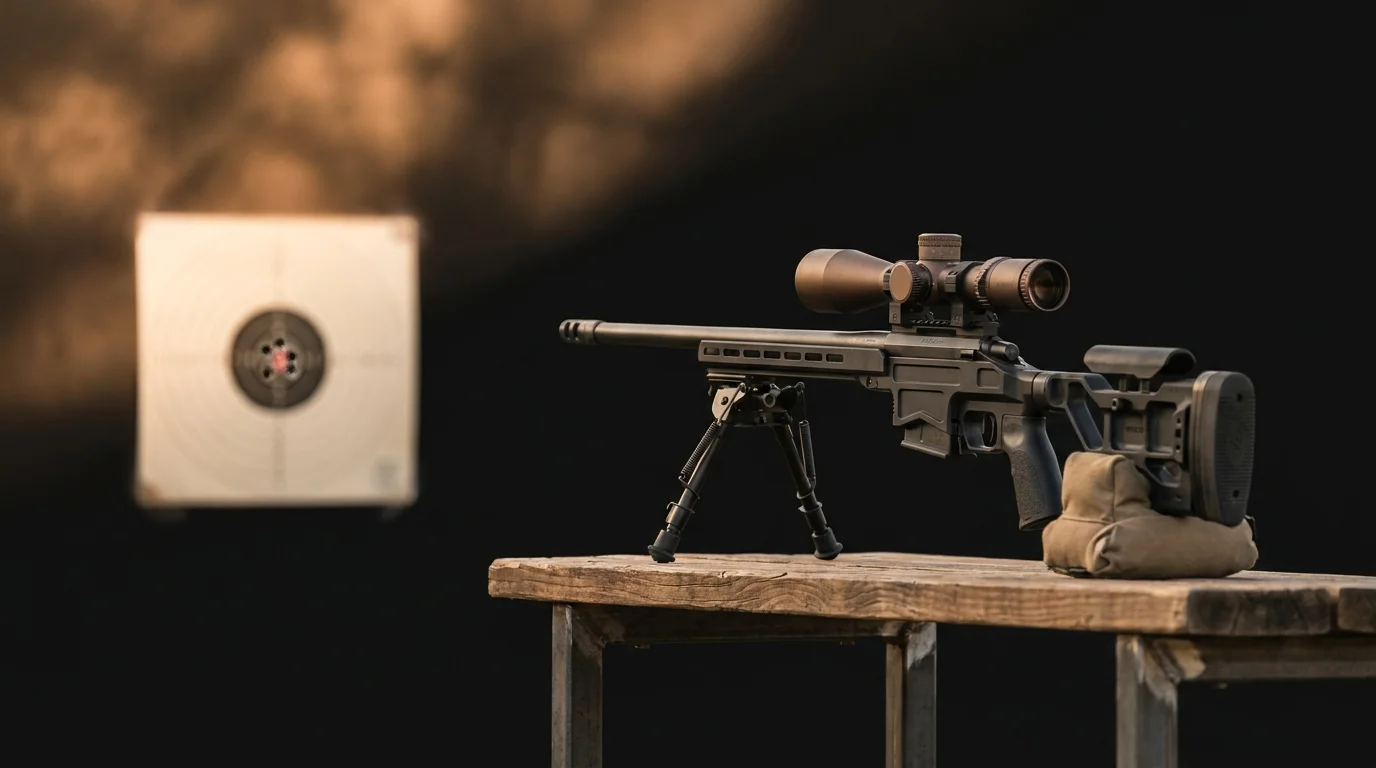
Why zeroing matters
Your sight and your bore aren't physically aligned in 3D space — the sight sits 1.5-3 inches ABOVE the bore axis. When you point the sight at a target, the bore is pointed slightly downward relative to the sight. A "zero" is the distance at which the bullet rises through the line of sight to intersect it. Past that point, gravity pulls the bullet below the line of sight.
Zeroing is essentially calibrating where the sight aims relative to where the bore points, so that point-of-aim equals point-of-impact at your chosen distance.
Pick a zero distance first
| Zero | Best for | Trade-offs |
|---|---|---|
| 50/200 yd | AR-15 / 5.56 carbine for general use | Bullet rises to ~2" high at 100 yd; complex math past 250 yd |
| 100 yd | Bolt-action precision, hunting, scope-equipped rifles | More holdover required at 200+ yd |
| 50 yd | Indoor / short-range / pistol-caliber carbines | Bullet drops significantly past 100 yd |
| 25 yd | Indoor range with no further options; .22 LR / training rifles | Throws bullets ~6+ inches off at 100+ yd |
| 200 yd | Hunting rifles, longer-range carbines | Bullet impacts ~1.5" high from 50-150 yd |
For an AR-15: pick 50/200 unless you have a specific reason otherwise. For a bolt-action rifle or scoped hunting rifle: 100 yd is the standard. For a precision long-range rifle: 100 yd is cleaner because all your dope is "dial up from zero."
Step-by-step procedure (100-yard example)
Before you start
- Mount your optic correctly. Torque the mounting screws to spec (typically 15-25 in-lb for ring screws, 35-65 in-lb for the picatinny mount). A loose mount will shift zero unpredictably.
- Confirm bore-sight if possible. A laser bore sighter saves rounds. Alternatively, with the rifle on a stable rest, look through the bore at a distant target and align the sight with the bore's aim point.
- Set up a stable shooting position. Bench rest with sandbags, or prone with a bipod. You CANNOT zero from offhand — the wobble is bigger than the adjustment increments.
- Use consistent ammo. The ammo you'll actually use. Don't zero with cheap range FMJ and then carry premium JHP — different bullet weights and velocities shift point-of-impact.
The procedure
- Set a 100-yard target. Use a target with a clear aim point and a grid (1-inch squares help).
- Shoot a 3-round group. Aim at the center every shot. Don't adjust your aim between rounds even if you see where the first round hit.
- Measure group center. Find the rough center of the 3 holes. If they're widely scattered (>3 inches at 100 yds), stop and address the shooter — bipod tension, breathing, trigger press. Zero math doesn't work on bad groups.
- Calculate the adjustment. Measure how far the group center is from the aim point — in inches, both up/down and left/right.
For a scope with 1/4 MOA clicks at 100 yd: 1 inch = 4 clicks.
For a scope with 0.1 MIL clicks at 100 yd: 1 inch ≈ 3 clicks.
For iron sights or red dots, check your specific adjustment value. - Dial the adjustment. Move the elevation turret UP if your group is BELOW the aim point. Move the windage turret RIGHT if your group is LEFT of the aim point. (The turret direction and impact direction are intuitive — turret says "UP", impact moves up.)
- Shoot another 3-round group.
- Repeat if needed. Most rifles are zeroed in 2-3 groups (6-9 rounds). If you're past 4 groups, something is wrong: loose mount, scope tracking issues, shooter inconsistency.
- Confirm with a final 5-round group at the zero distance. If the group is centered on the aim point, you're done. Re-torque any scope mount screws. Record your final scope settings (turret position, click count from a reference) so you can re-zero quickly if it gets bumped.
The 25-yard confirmation method (for a 50/200 zero)
If you only have a 25-yard range available and you want to set up a 50/200 zero on an AR-15:
- Set up at 25 yards with a clear aim point.
- Shoot a 3-round group. Adjust the sights so the GROUP CENTER impacts approximately 1.5 inches BELOW the aim point. (Specific value depends on your sight height — measure from your scope/sight to the bore axis: with a 2.5-inch sight height, impacts should be ~1.5" low at 25 yd.)
- This puts you very close to a 50/200 zero. Verify at the actual 50-yard distance when you have the chance, but the 25-yard confirmation gets you 90% of the way there.
Common zero mistakes
- Shooting from an unstable position. Offhand at 100 yds = 6+ inches of wobble even from a competent shooter. Use a bench rest or prone with bipod.
- Adjusting after every single shot. Single shots are not signal — they're noise. Always shoot a 3-round group and adjust based on the group center.
- Changing ammo mid-zero. A 55gr FMJ and a 77gr SMK will have different points of impact from the same rifle. Use the ammo you'll actually use.
- Forgetting to re-tighten the mount. If you adjusted ring screws to align the optic before zero, re-torque them after. A loose ring is the #1 cause of mysterious zero drift.
- Not tracking turret direction. Some scopes (especially older ones) have non-intuitive turret directions. Read the turret cap or scope manual before dialing. The labels usually show "UP" arrows for elevation that mean "impact moves up."
- Zeroing on a windy day. A 10 mph crosswind moves a 5.56 round ~3 inches at 100 yds. Wait for calm conditions, or zero early morning before wind picks up.
Recording your zero
After confirming zero, write down:
- Date + range + temperature + ammo lot
- Turret position from a reference (count of clicks up from the lower limit)
- Zero distance (50/200, 100, etc.)
- Any specific notes about how the rifle was shooting
This data lives in your dope notebook (or our dope card builder) and lets you quickly re-establish zero after travel, mount work, or any change to the rifle.