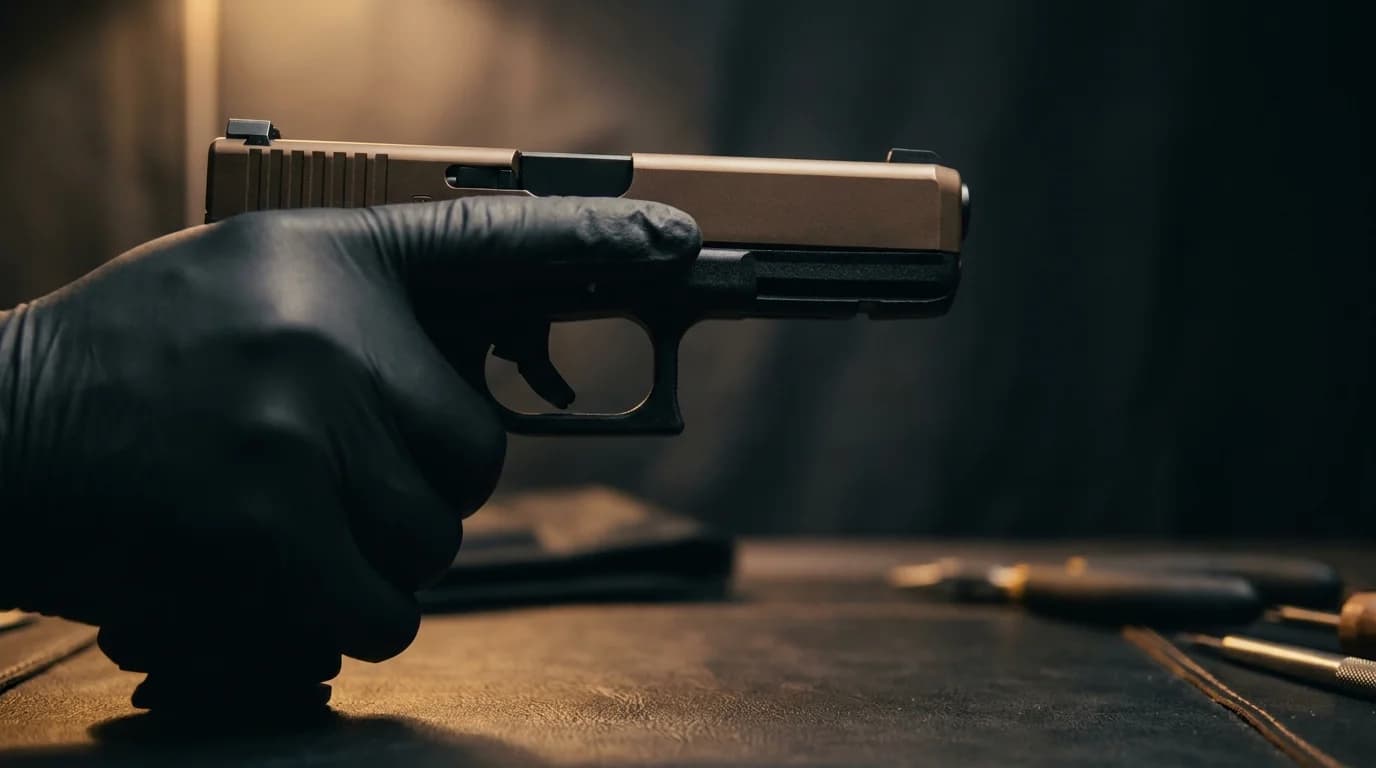
The Four Rules
Rule 1 — Treat every firearm as if it is loaded
Every time you pick up a firearm — yours, a friend's, a brand-new one out of the box — handle it as if it is loaded. Even if you JUST unloaded it. Even if the magazine is in your other hand. Even if the slide is locked back. Treat it as loaded.
The reasoning: nearly every documented negligent discharge starts with the phrase "I thought it was unloaded." Status confusion is the #1 cause of NDs. Removing the "is it loaded?" question entirely — by treating all firearms as loaded — eliminates the entire failure mode.
What this looks like in practice: when handed a firearm, immediately perform a chamber check yourself. Don't rely on the previous handler's assurance that it's clear. When showing a firearm to someone, hand it over with the action open and the chamber visibly empty.
Rule 2 — Never let the muzzle cover anything you are not willing to destroy
The muzzle is the business end. Point it only at things you are actively, deliberately willing to destroy. This includes:
- Your own body parts (don't holster a pistol toward your legs without a proper holster)
- Other people, even people behind walls (bullets penetrate drywall)
- Your house, your car, your pet
- Things downrange that aren't your target (the "what's beyond" question — Rule 4)
The reasoning: if the muzzle is pointed somewhere safe and Rule 3 fails (negligent trigger press), the worst-case outcome is property damage, not injury or death. Muzzle direction is the last line of defense.
What this looks like in practice: a holstered pistol in a quality IWB holster (kydex, full trigger-guard coverage) has the muzzle pointing at the ground or at your femur — a known acceptable direction because the trigger is mechanically covered. An unholstered pistol always has a known muzzle direction. Sweeping the muzzle across your hand during reholster ("lasering yourself") is the single most common Rule 2 violation — it's why instructors constantly remind students to look at the holster mouth during reholster.
Rule 3 — Keep your finger off the trigger until your sights are on the target and you have decided to fire
Trigger finger discipline. The trigger finger lives ALONG THE SLIDE, above the trigger guard, indexed straight. It only enters the trigger guard when:
- The sights are on the target you intend to shoot
- You have made the decision to fire
The reasoning: trigger guards prevent SOME accidental trigger contact (clothing, holster brush, gloves), but they don't prevent finger-on-trigger errors. The only protection against an unintended trigger press is the shooter's finger not being on the trigger.
What this looks like in practice: on the draw, the finger comes out of the holster INDEXED on the frame, only moves to the trigger as the gun rises to eye level. Between targets, finger comes off the trigger and re-indexes. Reholstering, finger always comes off the trigger first. Many instructors call this "the register" — physically pressing the trigger finger against the slide is positive tactile feedback that you're not on the trigger.
Rule 4 — Be sure of your target, and what is beyond it
Identify what you're shooting at before you shoot. Then identify what's beyond it — because bullets don't always stop at the target. A 5.56 round will pass through several layers of drywall. A 9mm hollow-point will travel 800+ yards if it misses or over-penetrates.
The reasoning: Rules 1-3 protect against unintended discharges. Rule 4 protects against intended discharges hitting unintended targets — bystanders behind your intended target, partners downrange, walls between you and the room beyond.
What this looks like in practice: at the range, verify backstops can actually stop your ammo. In a home defense scenario, know which interior walls your defensive ammo will/won't penetrate. Hunting, never shoot at sound or motion — only at clearly- identified game with a known backstop (terrain, hillside). In daylight at the range, don't shoot through a target stand into the next bay without checking who's there.
Why the rules work as a system
Examine a hypothetical negligent discharge: a shooter is cleaning a pistol, doesn't verify it's empty (Rule 1 violation), has their finger on the trigger (Rule 3 violation), and the muzzle pointed at their leg (Rule 2 violation). The pistol fires. They're hit.
Each rule alone would have prevented the injury:
- Rule 1 followed: chamber check first → would have found the round → wouldn't have pulled trigger thinking it was empty.
- Rule 2 followed: muzzle not pointed at leg → bullet impacts the floor or wall, property damage but no injury.
- Rule 3 followed: finger not on trigger → no discharge.
- Rule 4 followed: aware of what's in line with muzzle → either changes orientation OR (if pointing at the leg) recognizes the danger.
The fact that injuries happen means TWO OR MORE rules failed simultaneously. The system works.
The corollary rules
Different schools layer on additional rules. The most common additions:
- Know your firearm. Understand the manual of arms, the safety mechanisms, and the limitations of YOUR specific gun before you carry it.
- Use proper ammunition. The right caliber, the right pressure spec (5.56 vs .223 — see our 5.56 vs .223 guide), no obstructions in the bore.
- Wear eye and ear protection. Every range session, every time. Not optional.
- Don't handle firearms while impaired. Alcohol, drugs, medications affecting judgment — none of them mix with firearms. Many states have statutory prohibitions on this in addition to the safety rationale.
- Store firearms properly. Locked, secured against unauthorized access (especially from children), separately from ammunition when not in defensive use. Some states have statutory safe-storage requirements.
Teach these to anyone you take to the range
First time at a range with a friend or family member? Cover the Four Rules BEFORE they touch a firearm. Make it a ritual:
- Recite the rules out loud together.
- Demonstrate each rule physically with an unloaded firearm.
- Walk through the chamber-check procedure (visual + tactile).
- Establish the safe direction for the day — "downrange is that way, always."
- Tell them what to do if they violate a rule (don't be embarrassed — fix the position immediately).
The Four Rules aren't just a checklist. They're the operating system of safe firearm handling. Practice them so deeply that they become unconscious habit — that's when the safety system actually works.