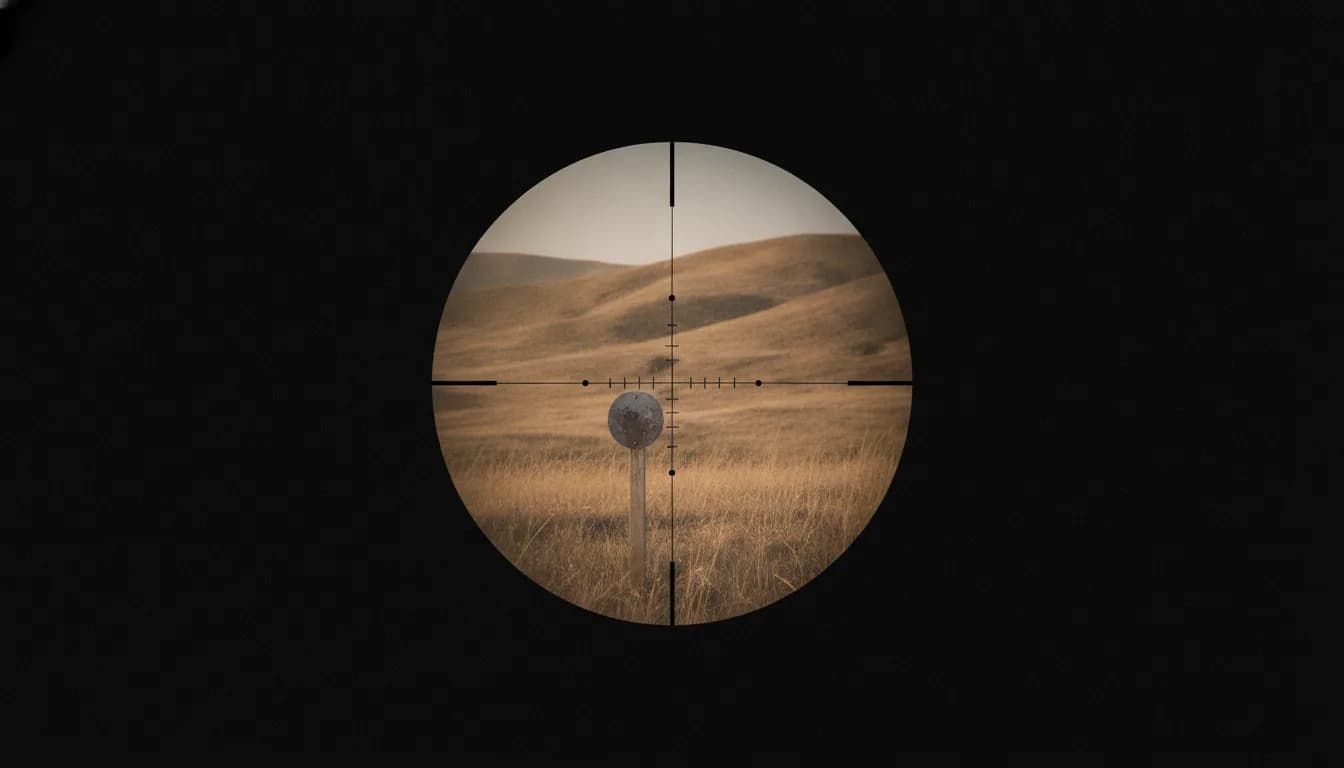
Mil Dot Range Calculator
Estimate range with your reticle.
Measure a target of known size in MILs or MOA and get the distance in yards and meters.
Estimated range
333 yds
In meters
305 m
On a second-focal-plane scope the reticle only measures true at one magnification, usually the highest. First-focal-plane reticles read true at every power.
How to range with a mil-dot reticle
- Pick a part of the target whose size you know: a steel plate, a target frame, a fence post.
- Measure it in the reticle, edge to edge, to the nearest tenth of a MIL (or quarter MOA).
- Enter the size and the reading above, or use the formula: yards = inches × 27.78 ÷ MILs.
- Feed the distance into your dope card or the ballistic calculator to get your hold.
New to the units? See what a milliradian is and the MOA and MIL calculator for conversions and scope clicks.
Mil-dot ranging: common questions
What is the mil-dot range formula?
Range in yards = target size in inches × 27.78 ÷ size in MILs. In metric, range in meters = target size in meters × 1,000 ÷ MILs. For an MOA reticle, range in yards = size in inches × 95.5 ÷ size in MOA.
How accurate is mil-dot ranging?
It's only as good as your size estimate and your reading. Misjudge an 18-inch target as 20 inches and your range is about 11% long, which matters a lot past 400 yards. Reading to a tenth of a MIL on a small target is hard, so a laser rangefinder is the better tool when you have one.
Does magnification matter for mil-dot ranging?
On a second focal plane scope, yes: the reticle only measures true at one magnification, usually the highest setting, and readings at other powers are wrong. On a first focal plane scope the reticle scales with the image, so it reads true at any power.
What size should I assume for common targets?
Use the most precise known dimension you can see. A standard steel plate or IPSC target has a known size. For deer, a chest depth of about 18 inches is a common working figure, but animals vary, which is one reason hunters prefer a rangefinder.
Why is the number 27.78?
It's 1,000 ÷ 36. A MIL is 1/1,000 of the distance, so range equals size × 1,000 ÷ MILs when size and range share a unit. Measuring size in inches and range in yards (36 inches per yard) turns the 1,000 into 27.78.
Be first
Get the Chambered app the day it launches.
Your rifles, loads and dope cards in one place, plus state-law-change alerts. No marketing fluff. Unsubscribe with one click.